
This is part two of our series on postpartum mental health. Part one covered how to prepare. This part looks at what is happening in the body, because understanding the biology helps explain why the weeks after birth can be such a vulnerable time for mood.
What changes at delivery
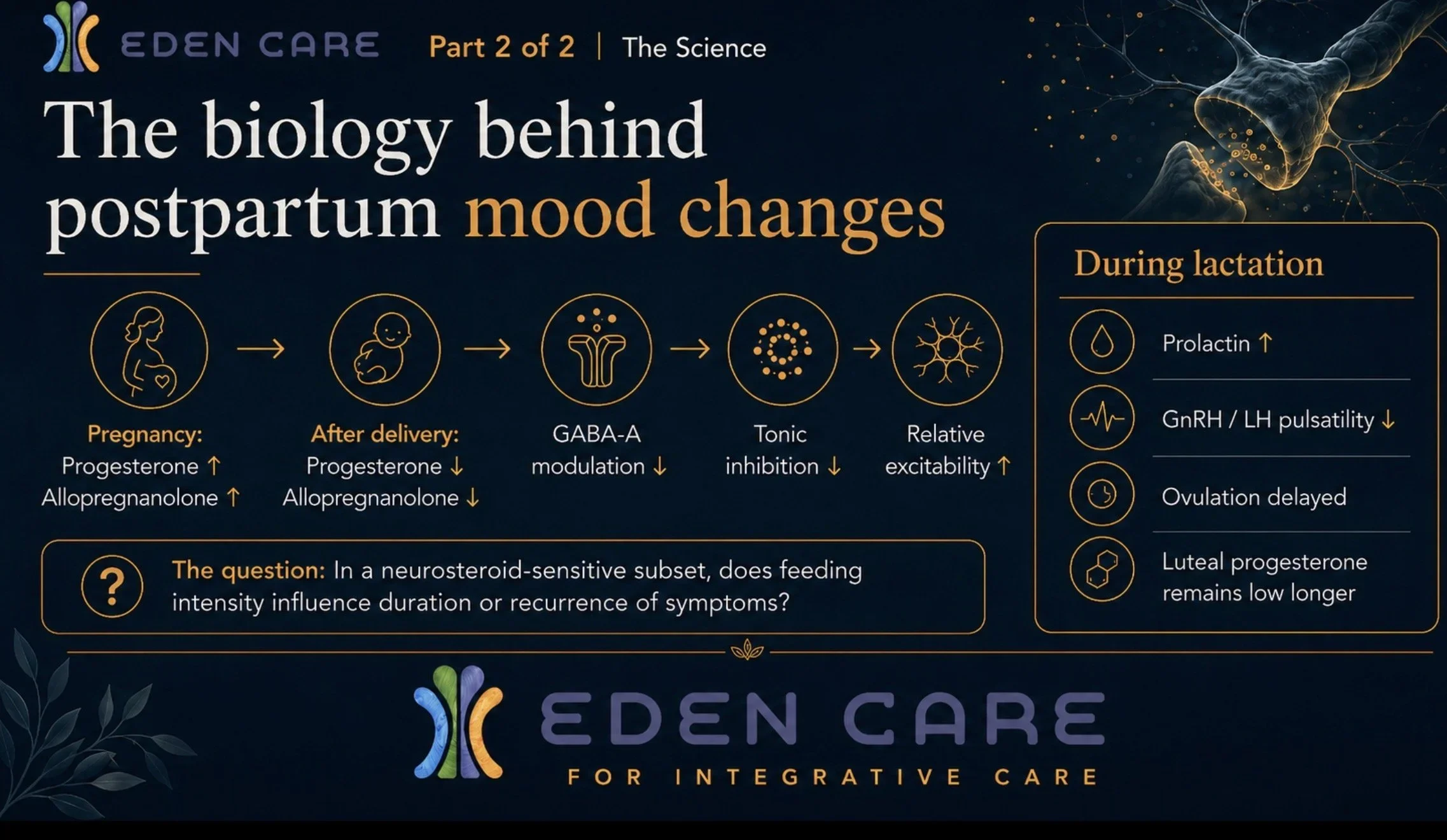
During pregnancy, progesterone rises to very high levels. So does allopregnanolone, a compound the body makes from progesterone. Allopregnanolone acts on GABA-A receptors, part of the brain's main calming system.
After delivery, both drop quickly. With less allopregnanolone, there is less of that calming signal, sometimes described as reduced tonic inhibition. The brain is left relatively more excitable while it adjusts to the change.
Every woman goes through this hormonal shift, and most do not develop a mood disorder. Researchers think some women may be more sensitive to the change than others. That is one reason the hormonal transition is best understood as a source of vulnerability and not as a diagnosis or a single cause. Sleep loss, stress, support, personal history, and genetics all matter too.
What changes during lactation
Prolactin rises
The hormone signals that restart the menstrual cycle (GnRH and LH) slow down
Ovulation is delayed
Progesterone made after ovulation stays low for longer
An open question
This raises a question researchers have not yet answered. In women who are especially sensitive to these hormone changes, does the intensity of feeding influence how long symptoms last or whether they return?
We do not know. This is a question for research, not a reason to change how you feed your baby. Feeding decisions are personal and should be made with your own clinicians.
Why this matters
Postpartum mood and anxiety symptoms have a biological basis. They are not a sign of weakness or of a lack of love for your child. They are also treatable, and it is always reasonable to ask for an evaluation.
If you need help now
If you or someone you know is in crisis, call or text 988 for the Suicide and Crisis Lifeline. For perinatal-specific support, Postpartum Support International operates a helpline at 1-800-944-4773. In an emergency, call 911 or go to the nearest emergency department.
To talk with our team about care during pregnancy or after delivery, start with our new patient intake or call 518-636-5284.
This article is general education and is not a substitute for care from your own clinician.
